A Bournemouth Landmark Checklist for Reading the Streets Around a Famous Building
Use this Bournemouth landmark checklist to read a famous building’s edges, routes and nearby spaces, and see how it fits into the wider neighbourhood.
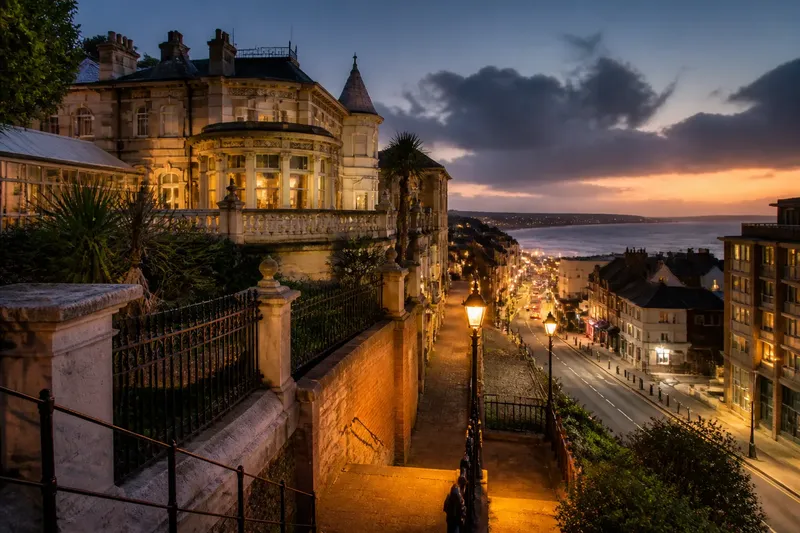
At the Russell-Cotes Art Gallery and Museum, a visitor might pause above the seafront, take a photograph and move on. A Bournemouth landmark checklist begins just beyond that frame: with the approach, the change in ground, the neighbouring buildings and the paths that draw people onwards. A famous building gives a place a memorable face; its surroundings show how that face belongs to the town.
Landmarks are easy to recognise and just as easy to isolate. A grand façade can become shorthand for a district, even when nearby streets have different stories, uses and scales. Use the checklist below to notice the edges, routes and public spaces that put a building in context.
- Check the boundary. If a garden wall, railing or open forecourt separates the building from the pavement, note how people enter or pass by; if the boundary is unclear, look for the point where public space meets the building.
- Check the view away from the entrance. If the reverse view reveals ordinary streets or another public space, include them in your sense of the setting; if it reveals little, shift to a nearby street or open area.
- Check the approach. If the building comes into view gradually or suddenly, record where that happens; if the approach is obstructed or unclear, choose another public viewpoint rather than infer the intended route.
- Check the route onward. If a public path continues towards another place, follow it only as far as the next clear space or change in street character; if it ends at a threshold, note that instead of assuming the landmark connects to more.
- Check changes in level and access. If steps, slopes or crossings shape who can move through comfortably, record the visible difficulty; if the route is inaccessible or unsafe to follow, observe from a suitable public position.
- Check a nearby space. If a square, garden, pavement widening or seafront area offers a different view or place to pause, compare it with the landmark’s immediate setting; if no nearby space is apparent, use a second street viewpoint.
Read the edges where the building meets everyday town life
An edge is where a landmark meets an ordinary street: a garden wall beside a pavement, a forecourt opening towards a road, or a tall frontage set against smaller buildings. These boundaries show whether the building turns towards its surroundings, keeps them at a distance or changes character from one side to another.
At Russell-Cotes, notice how the house’s elevated position relates to the lower seafront and the routes below. The building commands attention, but its connection to nearby streets and open areas matters too. Look at how its scale sits against the coastal setting, while remembering that a single view cannot explain the whole site.
An edge-reading visit suits someone who enjoys architectural detail or has little time. Stand where the building and street are visible together, then turn around. The view away from the landmark may reveal a change in street character, a connection to another public space or an unremarkable frontage that its reputation tends to eclipse.
Notice barriers as well as openings. Railings, changes in level, planting and entrance placement all shape how people encounter a building, but they do not necessarily share one purpose. Describe what you can see before deciding what it means.
Follow public routes to see how a landmark connects
A route-based reading asks how people reach a landmark and what else lies along the way. Streets, crossings, slopes and pedestrian paths bring visitors from somewhere and send them onwards, placing the building in a sequence rather than leaving it as a lone object.
Choose a public approach and notice transitions. Does the street narrow or open out? Does the view appear suddenly, or grow as you walk? Is there a clear route onward to another public space, or does the visit seem to end at the threshold? Such details reveal practical relationships a photograph can hide.
Imagine approaching a prominent building on a sloping public street, then noticing a side route towards a small open space. You record the starting point, follow the side route to that space, and look back: the resulting view shows the building as one point in a larger pattern of access and outlook. This invented situation does not describe a particular Bournemouth route; it illustrates how following a connection changes the question from “What is this building?” to “What does it connect?”
Not every nearby path belongs to a single designed scheme. Routes change or serve several purposes, so keep the observation modest: note where a path begins, what it connects and what changes along it.
Compare nearby spaces to widen the frame
Sometimes the best way to understand a landmark is to step away from it. A nearby square, garden, pavement widening or seafront space can show how the district accommodates people who are not visiting the famous building. These places may support waiting, meeting, passing through or looking out. Their everyday use belongs to the neighbourhood’s character, even if no single structure gives them a name.
Compare two spaces that differ in position or use. Ask what each makes possible: a broad view, a quiet pause, a direct crossing or a connection between streets. Then notice what may make access awkward. A change in level, a busy crossing or a narrow path can alter the experience without appearing in a tourist image.
This approach is useful when the building’s immediate setting is too small to represent the district. Keep the comparison grounded in what is present rather than assuming why a space was made or who it was intended for.
There is no need to turn the walk into a survey. A few notes about sightlines, boundaries, routes and public spaces offer more to consider than an inventory of every sign, bench and paving change. It is not worth trying to assign a definitive meaning to each detail on the spot; record what you observe and leave uncertain explanations open.
Which landmark-reading approach suits your visit?
What should I look at first around a famous building?
Begin where the building meets the pavement, garden or open space, then look away from its main entrance. Those angles show how the landmark meets its surroundings and what the familiar view leaves out.
Should I follow a route or stay close to the landmark?
Stay close if architectural edges and scale interest you most; follow a public route if you want to understand movement and connection. If time allows, start at the building and walk as far as the next public space or clear change in street character.
How many nearby spaces should I compare?
Two spaces are enough to make a useful comparison without turning the visit into a catalogue. Choose places that differ in position or use, such as a street edge and a place to pause, and describe what each lets people do.
How can I avoid treating one view as the whole neighbourhood?
Change position and direction: look towards the landmark, away from it and along an adjoining route. Note what remains outside your view, especially ordinary streets and public spaces absent from the familiar image.
Keep observations separate from interpretations
For a short visit, read the edges. Choose a route when your question concerns movement, or compare nearby spaces when you want to understand what the surroundings offer beyond the landmark itself. These approaches can sit side by side: a close look at a boundary may lead naturally to a walk or a second viewpoint.
A useful record can be as simple as three observations: what borders the building, how people approach or leave it, and what nearby space changes the experience. Keep description separate from interpretation. “The frontage faces a public street” describes what is visible; “the building was designed to welcome everyone” is a broader claim that needs evidence beyond a casual walk.
This Bournemouth landmark checklist helps a famous building remain important without asking it to stand in for every street around it. On your next visit, note a detail at the edge, a connection along a route and a nearby place where the building is no longer the main event. Those observations can give you a more useful sense of the neighbourhood than another photograph from the same familiar angle.